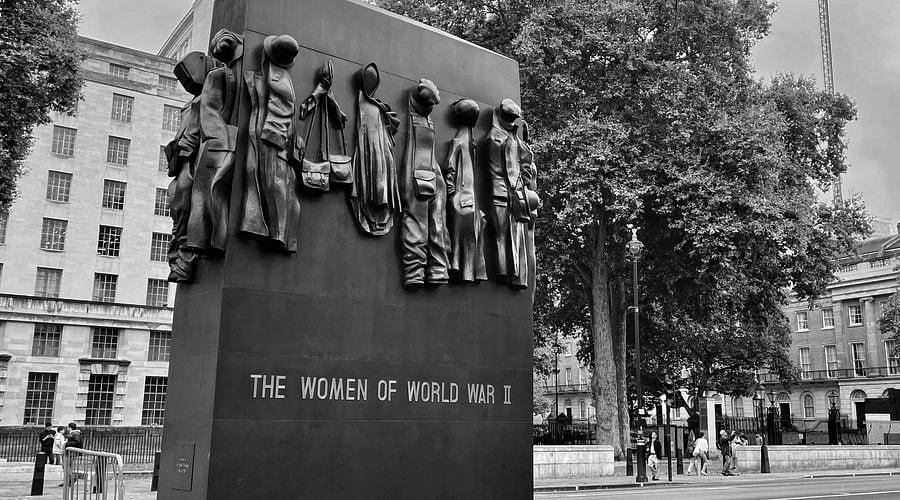

For decades, the vital contribution of women during the Second World War remained largely unappreciated. Millions of them stepped up, working as mechanics and engineers, in munitions factories and civil defence services, driving buses and fire engines. While the USA, Canada, and Australia had long since erected monuments honouring their heroines, it took 60 years for the United Kingdom to establish its own symbol of gratitude: the Monument to the Women of World War II. Read more on london-yes.
The Journey to the Monument: Conception and Unveiling
The idea for the Monument to the Women of World War II was born in 1997, thanks to the initiative of retired Major David McNally Robertson. Initial efforts to commemorate the servicewomen were modest, limited to plans for a memorial plaque in York Minster. Robertson quickly joined forces with former gunners Edna Storr and Mildred Veal, establishing a dedicated fund to raise the necessary money. They were soon joined by ITV journalist and producer Bill Morali and Perry Langdale. Crucially, the campaign gained momentum with the support of highly influential figures. These included Betty Boothroyd, the former Speaker of the House of Commons, the singer Vera Lynn, and the Princess Royal. Boothroyd became the fund’s patron, with Lynn and Princess Anne serving as vice-patronesses.
The public’s effort successfully raised over £300,000. A significant boost came from the National Heritage Memorial Fund, which allocated more than £900,000 towards the creation of the bronze sculpture. Baroness Boothroyd made a separate, notable donation of £8,000, which she won on the popular television game show Who Wants to Be a Millionaire? in 2002. The remainder of the funding was secured by the Memorial to the Women of World War II Fund.
The monument was officially unveiled on 9th July 2005. Queen Elizabeth II led the ceremony as part of the 60th-anniversary commemorations of the end of the Second World War. Among the special guests was Nancy Wake, the most highly decorated servicewoman among the Allies. The unveiling was marked by a spectacular flypast over London featuring five military helicopters: an Apache, Sea King, Lynx, Chinook, and Merlin. They were followed by two Panavia Tornado ADV fighter jets, notably piloted by women.
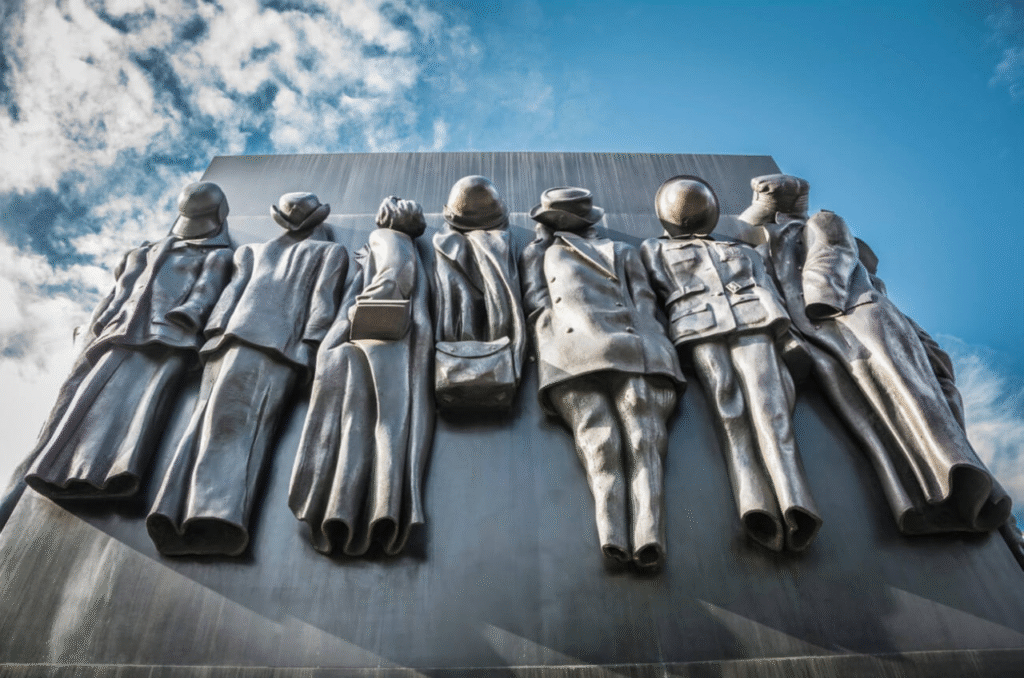
The initial design concept for the Monument to the Women of World War II proposed an emotional composition featuring an air raid warden shielding children during a bombing raid. However, the idea was later simplified. The goal shifted to focus attention not on a single figure, but on the thousands of women who contributed to the victory. The resulting bronze sculpture stands at 6.7m high, 4.9m long, and 1.8m wide. Its sides feature 17 sets of women’s clothing and uniforms, giving the impression that the women have just momentarily stepped away from their posts. These include the uniform of the Auxiliary Territorial Service (ATS), the Women’s Royal Naval Service (WRNS) uniform, a nurse’s cape, a police jumpsuit, and even a welder’s mask, symbolising women’s participation in heavy industry.
In May 2015, following the Conservative Party’s General Election victory, the monument was defaced. The words ‘Tory scum’ were spray-painted in red graffiti on its surface. This act of vandalism sparked widespread national outrage. Police subsequently arrested at least 17 people after clashes erupted in Whitehall, close to where the monument stands.
The Recognition and Significance of the Monument
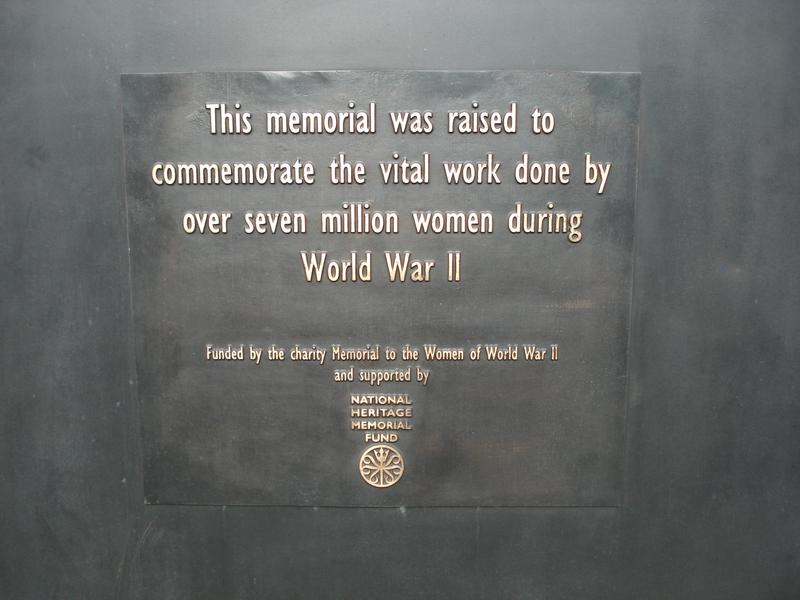
The Monument to the Women of World War II has become a vital national military memorial, blending history, art, and profound public gratitude. The sculpture symbolises the contribution of over seven million British women who undertook hundreds of essential professional roles during the war. This figure includes more than 650,000 women who voluntarily joined the armed forces. They served in military units, and worked in factories, hospitals, and in communication and defence systems, taking on duties that were previously considered exclusively male.